


Syllabus: GS1/Society; GS2/Social Issues; Vulnerable Sections
Context
- The government has said that the Bal Vivah Mukt Bharat campaign is aimed at reducing the prevalence of child marriage by 10% by 2026 and making India child marriage-free by 2030.
What Is Child Marriage
- Child marriage, defined under Prohibition of Child Marriage Act is any union where the female/girl party is under 18 years and a male below 21 years of age, perpetuates cycles of poverty, gender inequality, and health risks, particularly in rural and tribal areas.
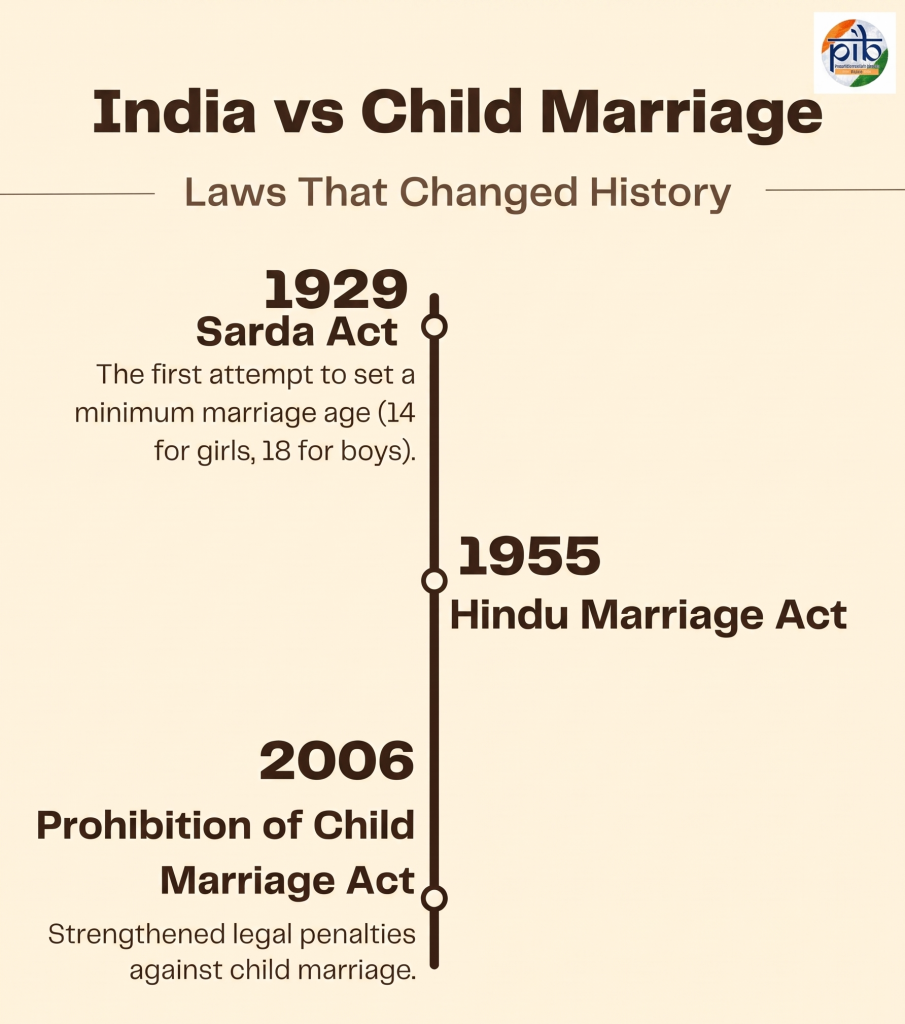
- As per the Bharatiya Nyaya Sanhita, 2023, any sexual act by a man with his wife who is below 18 years of age amounts to rape.
- The Supreme Court of India has further clarified that when the husband of a child bride commits penetrative sexual assault on her, it amounts to aggravated penetrative sexual assault, an offence punishable under the Protection of Children from Sexual Offences (POCSO) Act, 2012.
Current Status of Child Marriage in India
- India has witnessed a gradual decline in child marriage, but its prevalence remains a significant concern.
- According to NFHS-5 (2019–21), 23.3% of women aged 20–24 were married before attaining 18 years, compared with 26.8% in NFHS-4 (2015–16).
- The practice is disproportionately concentrated in economically disadvantaged and rural communities.
- Significant interstate and intrastate variations highlight the need for region-specific interventions.
- The government has identified 257 high-burden districts for focused action under the national campaign.
Reasons for Child Marriage
- Poverty & Economic Insecurity: Families sometimes consider early marriage a means of reducing financial responsibilities.
- Gender Discrimination: Patriarchal attitudes often prioritise marriage over girls’ education and independence.
- Lack of Education: School dropout, inadequate educational infrastructure and limited access to secondary education increase vulnerability.
- Social & Cultural Traditions: Community pressure, customary practices and concerns about family honour reinforce early marriage.
- Safety Concerns: Fear of sexual harassment and perceived insecurity sometimes leads families to arrange early marriages.
- Weak Law Enforcement: Inadequate awareness, underreporting and insufficient institutional capacity allow the practice to continue.
Key Legislation: Prohibition of Child Marriage Act, 2006
- It provides the principal legal framework to prevent child marriage. Its key provisions include:
- Section 3: Child marriages are generally voidable at the option of the contracting party who was a child at the time of marriage.
- Section 12: Certain marriages, including those involving force, deceit, sale or trafficking, are void.
- Section 13: Courts can issue injunctions to prevent child marriages.
- Section 16: Provides for the appointment of Child Marriage Prohibition Officers (CMPOs).
- Section 9–11: Prescribes punishment for adult male persons marrying a child and those performing, promoting or permitting child marriages.
- The Act provides for maintenance and residence for the female contracting party and legitimacy of children born from such marriages.
Efforts by the Judiciary
- Independent Thought v. Union of India (2017): The Supreme Court read down the marital rape exception under the IPC for wives aged 15–18, strengthening the protection of minor girls.
- Society for Enlightenment and Voluntary Action v. Union of India (2024): The Supreme Court issued important directions to strengthen the implementation of the PCMA, including awareness generation, institutional coordination, training of authorities and effective prevention mechanisms.
Other Related Initiatives
- Beti Bachao Beti Padhao (BBBP), 2015: It seeks to address gender discrimination, improve the survival and protection of the girl child and promote girls’ education.
- It complements the fight against child marriage by challenging discriminatory social attitudes and encouraging investment in girls’ development.
- Bal Vivah Mukt Bharat (BVMB) Campaign, 2024: It aims to make India child marriage-free by 2030. Its major features include:
- Mobilisation of Panchayati Raj institutions, educational institutions, religious leaders, civil society organisations and local administrations.
- Identification of vulnerable districts and focused community-level interventions.
- Appointment and mobilisation of Child Marriage Prohibition Officers.
- Promotion of girls’ education, awareness and collective responsibility.
- Key Achievements of BVMB Portal:
- 6.85 lakh awareness programmes conducted.
- 12.47 crore participants reached.
- 42.01 lakh pledges registered.
- 71,882 CMPOs reflected on the portal, including 59,686 designated at the Gram Panchayat level.
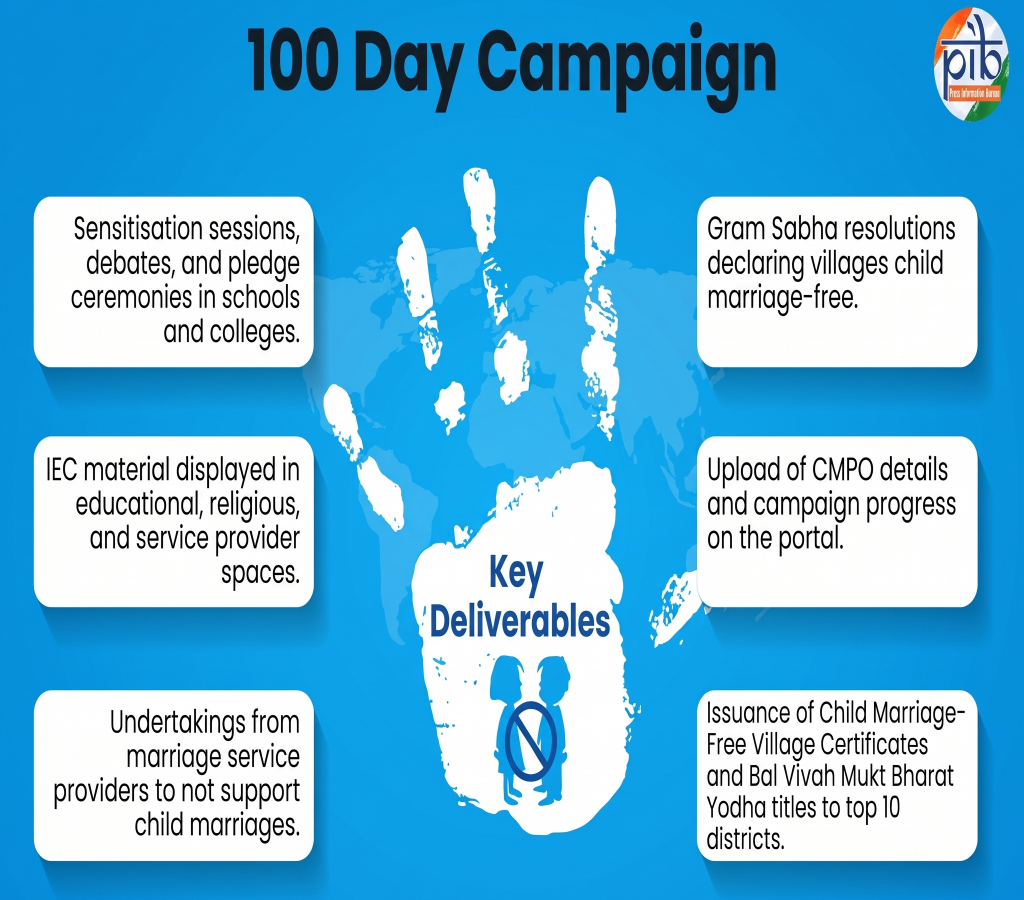
- 100-Day Special Awareness Campaign: It represents an intensive effort to translate national objectives into community-level action.
- It emphasises awareness generation, stakeholder participation, identification of vulnerable children and timely intervention by local authorities.
Way Forward
- Achieving the 2030 target requires a comprehensive strategy:
- Education: Ensure universal access to quality secondary education, particularly for girls.
- Economic Empowerment: Expand skill development, livelihood opportunities and financial support for disadvantaged families.
- Institutional Strengthening: Improve the capacity, accessibility and accountability of CMPOs.
- Community Participation: Engage parents, religious leaders, teachers and Panchayats in changing social attitudes.
- Technology-enabled Governance: Strengthen digital reporting, district-level monitoring and timely grievance redressal.
- Convergence: Integrate child marriage prevention with schemes relating to nutrition, health, education and women’s empowerment.
Previous article
Supreme Court OBC Creamy Layer Ruling
